Stair Runner Installation in Toronto: Cost Per Step, Materials and What’s Included
A stair runner is one of those home improvements that looks simple until you start pricing it.
The staircase might have only 13 or 14 steps, but the final cost can vary considerably depending on the runner, padding, installation method, staircase layout and condition of the existing stairs.
A basic synthetic runner on a straight staircase is a relatively straightforward installation. A patterned wool runner on a staircase with winders or a landing is a different job altogether.
If you’re comparing stair runner quotes in Toronto, the useful number isn’t simply the price per step. You need to know what the price includes.
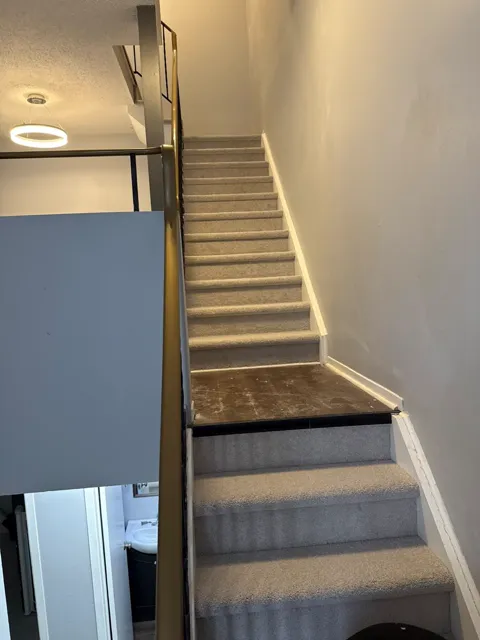
How Much Does a Stair Runner Cost in Toronto?
For budgeting purposes, a stair runner installation can range from several hundred dollars for a straightforward synthetic runner to well over $1,000 for a premium wool runner or a more complicated staircase.
A typical 13-step staircase is a useful example.
A lower-cost installation might involve:
- A basic nylon or polypropylene runner
- Standard padding
- A straight staircase
- No existing carpet to remove
- No complicated pattern matching
- A straightforward installation
At the other end, the same 13 steps could cost substantially more if the runner is a premium wool product, has a strong pattern or border, requires careful pattern matching, or involves more detailed fitting.
Why We Don’t Recommend Treating a Per-Step Price as a Fixed Rate
“Price per step” is convenient when you’re trying to get a quick idea of the cost, but it can be misleading.
One contractor may quote $X per step including the runner, padding and installation. Another may quote a lower labour figure and charge separately for the carpet, padding, removal and binding.
Those two quotes aren’t really comparable.
Before deciding which price is better, find out:
- Which runner is being supplied
- How wide the runner will be
- Whether padding is included
- Which installation method is being used
- Whether removal of an existing runner is included
- Whether disposal is included
- Whether the runner needs to be bound or otherwise finished
- Whether winders or landings cost extra
- Whether stair repairs are included
- Whether taxes are included
That information is much more useful than a single per-step figure.
What Does a Stair Runner Actually Cost?
The runner itself is only one part of the job.
For a straight staircase, the main cost components are usually the carpet, padding and installation labour. Additional work can include removing an existing runner, preparing the stairs, binding the carpet, dealing with winders and matching patterns.
Material choice makes a noticeable difference.
Basic Synthetic Runner
A basic synthetic runner is generally the most economical option.
Nylon and polypropylene are common choices, although the quality and construction of the actual carpet matter. A low-cost synthetic runner and a high-quality nylon runner shouldn’t be treated as equivalent simply because both are synthetic.
For a simple staircase in a rental property, basement or lower-traffic area, a basic runner may make sense.
For the main staircase in a busy family home, spending more on the carpet can be worthwhile.
Better-Quality Nylon or Wool Blend
This is often the middle ground.
A good nylon runner can provide durability without the price of a premium wool product. Wool blends can also be attractive when you want some of the appearance and feel of wool without choosing a 100% wool runner.
This category covers a wide range of products, so it’s worth looking at the actual carpet rather than relying on the label alone.
Premium Wool Runner
Wool is commonly chosen for higher-end staircases because of its appearance, feel and resilience.
Premium wool runners are also where the price can climb quickly.
A patterned wool runner with a border can require more material and more careful installation than a plain runner. The installer has to consider how the pattern will sit on each tread and riser, particularly when the staircase isn’t perfectly uniform.
For an older Toronto home with a staircase that is an architectural feature, the additional cost may be justified.
What Changes the Price of Stair Runner Installation?
Several things can turn a simple installation into a more involved project.
1. The Runner Itself
This is usually the most obvious difference between two quotes.
A basic synthetic runner costs much less than a premium wool product. Within each material category, however, there can also be significant differences in quality.
If you’re comparing quotes, ask for the manufacturer’s name and the exact product or collection rather than simply “wool runner” or “nylon runner.”
2. Runner Width
The most appropriate width depends on the staircase and the appearance you’re after.
Runners in the range of roughly 27 to 32 inches are common on residential stairs, but that doesn’t mean one of those widths is automatically correct for every staircase.
On a 36-inch-wide staircase, for example, a centred 27-inch runner leaves approximately 4.5 inches of exposed wood on either side.
Some homeowners prefer a narrower strip of carpet with more visible wood. Others want the runner to occupy more of the tread.
The installer should measure the staircase rather than selecting the width from a catalogue alone.
3. Staircase Layout
A straight flight is the easiest situation.
Winders, turns and landings make the job more complicated. The runner has to transition through the change in direction, and a pattern can make that considerably more noticeable.
If your staircase has a landing or several flights, make sure the quote specifically explains how those areas will be handled.
4. Existing Carpet
If you’re replacing an existing runner, there may be more work before the new one can be installed.
Ask whether the price includes:
- Removing the old runner
- Removing the old padding
- Pulling staples
- Removing tack strips where applicable
- Preparing the stairs
- Disposal of the old material
A quote that excludes these items can look cheaper at first.
5. Pattern Matching
Plain runners are relatively forgiving.
Patterned runners aren’t.
A geometric pattern, repeating motif or border needs to look intentional as it moves up the staircase. Small inconsistencies can become obvious once you see the entire flight.
Some patterns also result in more material being wasted during cutting.
If you’re choosing a patterned runner, ask the installer how the pattern will be positioned before the carpet is ordered.
6. Condition of the Stairs
Older staircases aren’t always perfectly uniform.
You may find:
- Loose boards
- Damaged tread edges
- Protruding nails or screws
- Old staples
- Uneven surfaces
- Previous carpet adhesive
- Worn or damaged wood
These problems don’t necessarily prevent a runner from being installed, but they may need to be dealt with first.
Ideally, the installer identifies these issues before installation day.
Choosing the Right Stair Runner Material
There’s no single material that’s best for every home.
Wool
Wool is the premium option for many residential staircases.
It has a natural feel and is available in a large range of colours and patterns. Quality wool can also hold up well to normal residential traffic.
The obvious downside is price.
If the staircase is the centrepiece of the house and you’re investing in a high-quality runner, wool can make sense. If you’re mainly looking for an inexpensive way to add traction and reduce noise, there are less expensive options.
Nylon
Nylon is a practical choice for busy residential stairs.
Quality nylon runners are available in many different styles and can provide good durability. They’re often a sensible choice when performance matters but a premium wool runner isn’t in the budget.
The important word is “quality.” Not every nylon carpet performs the same way.
Wool Blend
A wool blend can sit between 100% wool and synthetic carpet in terms of both price and characteristics.
The actual fibre mix matters, so ask what percentage is wool and what the other fibres are.
Polypropylene
Polypropylene is generally found among the more economical carpet options.
It can be appropriate for some applications where keeping the purchase price down is important. For a heavily used main staircase, however, it is worth comparing the product’s construction and expected wear rather than choosing it solely because it is inexpensive.
Sisal and Jute
Sisal and jute provide a very different look from conventional carpet.
They can work well in the right interior, particularly where a natural, textured appearance is wanted. But the texture that makes them attractive can also make them less comfortable underfoot than a conventional wool or nylon runner.
If you’re considering one of these materials for stairs, look at the actual product and discuss its suitability with the installer.
Waterfall vs. French Cap vs. Hollywood Installation
You’ll often hear these three terms when discussing stair runners.
The names describe how the carpet is fitted around the stairs.
Waterfall Installation
With a waterfall installation, the runner comes down the riser and flows over the front of the tread before continuing to the next riser.
It’s a relatively straightforward approach and works well with many simple staircases.
The finished appearance is somewhat less tailored than an individually fitted installation.
French Cap Installation
With a French cap installation, the carpet is fitted more closely around each tread and riser.
The result is a more defined, tailored appearance. It also requires more detailed fitting.
This can be particularly attractive on a staircase where the runner is intended to look like a deliberate architectural feature rather than simply a strip of carpet.
Hollywood Installation
Hollywood installation fits the runner closely around the front edge of each tread.
The result is a neat, fitted appearance that is often used on more formal or traditional staircases.
Terminology isn’t completely consistent between installers, so don’t choose an installation method based on the name alone. Ask the installer to show you photographs of completed projects using the method they’re proposing.
What Is Included in Stair Runner Installation?
A properly quoted installation should make the scope of work clear.
Measuring
The staircase is measured to determine the runner width, amount of material required and how the carpet will be positioned.
This is more important than it sounds. Older homes can have stairs that aren’t perfectly consistent from one step to the next.
Preparation
The stairs are inspected and prepared before the runner is installed.
This can include removing staples or other fasteners from an old installation and dealing with minor problems that would interfere with the new runner.
Major repairs should normally be identified and priced separately.
Padding
Padding is installed underneath the runner where appropriate.
More padding isn’t automatically better on stairs. The pad needs to provide the right amount of support and cushioning without making the runner unstable or changing the way it sits on the stair.
Ask what type and thickness of padding is included in the quote.
Cutting and Fitting
The runner is cut and fitted to the staircase.
A plain runner is relatively straightforward. A patterned runner requires more planning because the installer has to consider how the pattern will appear across the treads and risers.
Fastening
The runner is secured using the method appropriate for the staircase and installation style.
The fastening method is worth discussing if you have valuable original hardwood underneath.
Edge Finishing
The exposed edges need to be finished so the carpet doesn’t unravel.
Depending on the runner, this may involve binding, serging or another finishing method.
Ask whether edge finishing is included before ordering the carpet.
Cleanup
The installer should remove installation debris and leave the staircase in usable condition.
If old carpet is being removed, confirm whether disposal is included. It isn’t necessarily included in every installation quote.
Will a Stair Runner Damage Hardwood?
This is one of the most common concerns when installing a runner on an older staircase.
A runner has to be secured to the stairs, so some installation methods involve fasteners in areas that will be covered by the carpet.
That means it would be misleading to promise that installing a runner will leave absolutely no marks.
The visible wood on either side of the runner can remain exposed, however, which is one of the main reasons homeowners choose a runner instead of carpeting the entire staircase.
If you have original hardwood that you particularly want to preserve, tell the installer before the work starts. Ask where the runner will be fastened and what method will be used.
This is especially relevant in older Toronto houses where the staircase may be original to the property.
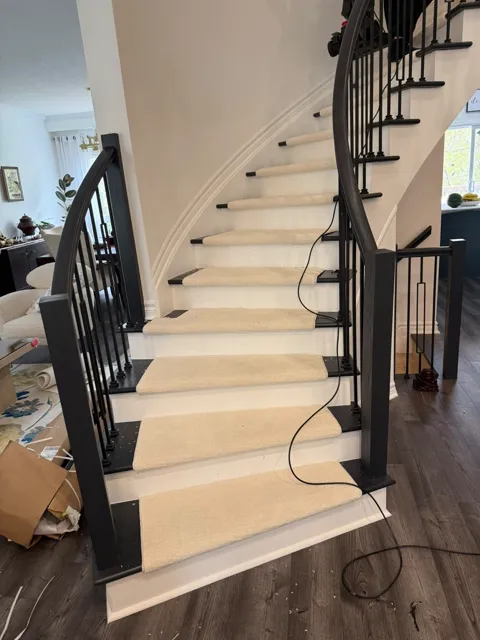
Is a Stair Runner Better Than Full Stair Carpeting?
It depends on what you’re trying to achieve.
| Option | Main advantage | Main drawback |
|---|---|---|
| Stair runner | Adds carpet while keeping the wood visible | More detailed installation |
| Full stair carpet | Covers the entire stair and provides a consistent carpeted surface | Hides the wood |
| Bare wood | Preserves the full appearance of the staircase | Less cushioning and noise reduction |
A runner is often the compromise homeowners choose when they like their staircase but don’t particularly enjoy walking on bare wood.
It can provide more traction and reduce footstep noise while leaving the stair edges visible.
What About Condos and Shared Staircases?
If the stairs are inside your own condo or townhouse unit, the project may be treated much like a residential installation.
Shared or common-area stairs are different.
Before making any purchase, check with the condo corporation, property manager or building management. There may be rules governing flooring, appearance, noise, fire performance or alterations to common areas.
Don’t order a custom runner for a shared staircase until you’ve confirmed that you’re allowed to install it.
What About Basement Stairs?
Basements deserve a little more attention because moisture can be an issue.
If the basement has a history of dampness, condensation or water intrusion, putting carpet on the stairs doesn’t solve the underlying problem.
The carpet, padding and installation should be selected with the conditions of the space in mind.
A contractor should also flag an obvious moisture problem rather than simply covering it with a new runner.
Commercial Staircases Are Different
A runner installed in a private home isn’t necessarily subject to the same requirements as one installed in a commercial building.
Commercial projects can involve requirements relating to fire performance, accessibility, slip resistance and the specific use of the building.
If the staircase is in an office, retail property, apartment building or other commercial setting, confirm the applicable requirements before selecting the runner.
Questions to Ask Before You Accept a Quote
Don’t compare quotes based on the final number alone.
Ask each installer:
- What exact runner is included?
- How wide will the runner be?
- What padding is included?
- Which installation method are you recommending?
- Is old carpet removal included?
- Is disposal included?
- Is edge binding or finishing included?
- Are winders and landings included?
- Are repairs to the stairs included?
- Is pattern matching included?
- Are taxes included in the quoted price?
- How long should the installation take?
- What happens if the condition of the stairs changes once the existing carpet is removed?
If two quotes answer these questions differently, you aren’t comparing two versions of the same job.
How Long Does Stair Runner Installation Take?
A straightforward residential staircase can often be installed in a day.
The schedule can change if the old carpet needs to be removed, the stairs need preparation, there are winders or landings, or the runner requires detailed pattern matching.
Multiple flights can obviously take longer than a single straight staircase.
If timing matters because you’re moving into a house or coordinating other renovation work, ask for an expected installation duration before booking.
Frequently Asked Questions
How much does a 13-step stair runner cost in Toronto?
There isn’t one reliable price for every 13-step staircase.
A basic synthetic runner on a straightforward staircase can be several hundred dollars installed. A higher-quality runner, particularly wool or a patterned product, can push the project into the $1,000-plus range.
The exact price depends on the runner, width, padding, installation method and condition of the stairs.
What is a normal stair runner width?
Residential runners are commonly around 27 to 32 inches wide, although the appropriate size depends on the staircase and the amount of exposed wood you want.
A 27-inch runner centred on a 36-inch staircase leaves roughly 4.5 inches of wood on either side.
Is wool better than nylon for stairs?
Not automatically.
Both can work well on residential stairs. Wool is attractive if you want a premium natural-fibre product, while quality nylon can provide strong durability at a lower price.
The construction and quality of the individual runner matter.
Is a stair runner cheaper than carpeting the whole staircase?
Not necessarily.
A runner uses less carpet, but the installation can require more precise fitting because the exposed wood edges need to remain clean and consistent.
The best way to compare the two is to get the complete installed price for the staircase rather than comparing material cost alone.
Can you install a runner over existing carpet?
Sometimes, but removing the old carpet and padding is generally preferable when the goal is a clean, properly prepared installation.
The existing carpet may be unsuitable as a base for the new runner, and leaving it in place can make it harder to inspect and prepare the stairs.
Your installer should assess the existing installation before recommending whether it can remain.
Will the runner damage my hardwood stairs?
Installation can leave small holes or marks in areas where the runner is fastened.
If preserving original hardwood is important, discuss the fastening method before the work begins. Don’t assume that every installation method will have the same effect on the underlying wood.
Does patterned carpet cost more?
It can.
A pattern may require additional material and more careful cutting and positioning. The effect is especially noticeable on stairs because the pattern is repeated across multiple treads and risers.
Do I need padding under a stair runner?
Padding is commonly used, but the correct specification depends on the runner and installation method.
The thickest pad isn’t necessarily the best pad for stairs. Stability and the way the runner sits on the stair are important.
How much should I budget?
Start with the staircase itself rather than a generic per-step number.
For a useful quote, specify the approximate number of steps, runner material and width, and whether you’re replacing an existing runner. The installer can then account for padding, labour, fitting and any unusual features of the staircase.
Getting a Stair Runner Quote in Toronto
The easiest way to avoid surprises is to have the staircase measured before choosing the runner.
For a straightforward project, an installer should be able to tell you what runner they’re recommending, how much material is required, what padding will be used and how the runner will be installed.
If you’re comparing several Toronto or GTA contractors, ask each one to quote the same scope of work. That means the same runner, width, padding, installation method and removal requirements.
The cheapest number isn’t necessarily the cheapest installation.
A quote that includes the carpet, padding, fitting, removal and cleanup may be better value than a lower labour-only price that leaves several costs to be added later.
Carpet Experts Toronto provides stair runner and stair carpet installation in Toronto and the GTA. If you’re considering a runner, the company can assess the staircase, discuss suitable materials and provide a project-specific quote.
The important thing is to compare the complete installation rather than focusing only on the price per step.